
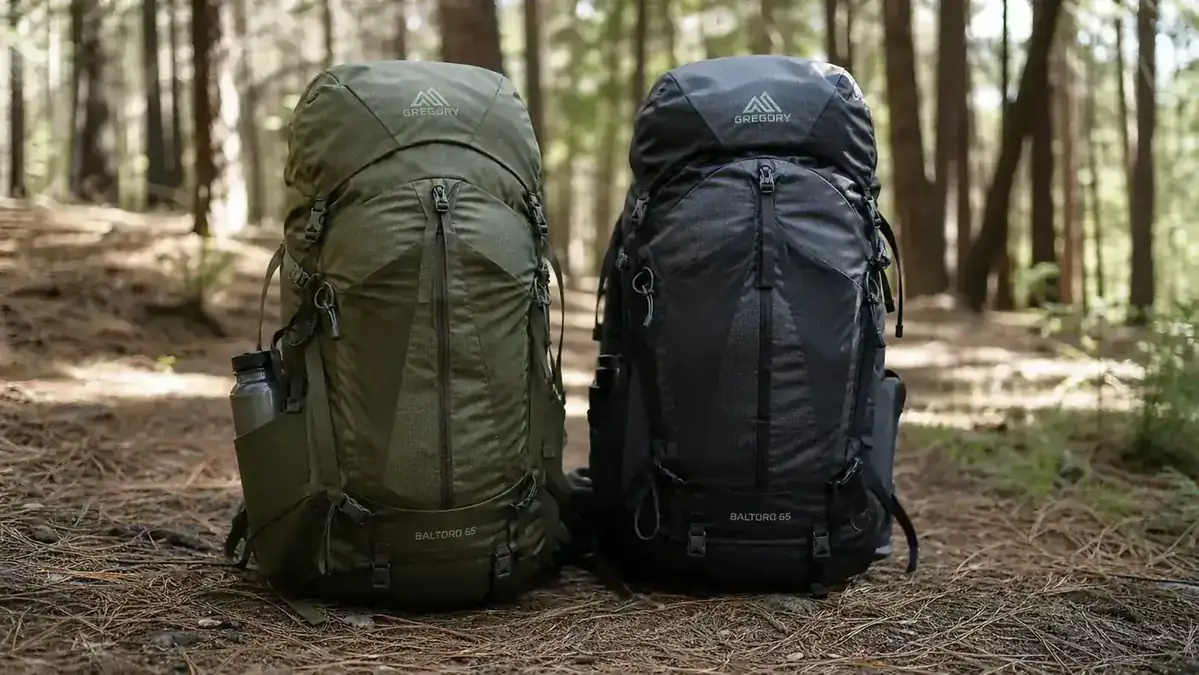
If you're shopping for a budget 50L hiking backpack, you've probably run into both the Loowoko 50L and the Maelstrom at some point during your search. They live in the same price range, they promise similar features, and half the photos on both Amazon listings look almost identical. So which one actually holds up when you're nine miles in and the trail turns muddy? I spent two back-to-back overnight weekends carrying both to find out. One trip with the Loowoko, one trip with the Maelstrom, same route, same gear load. I wanted an apples-to-apples read, not a spec-sheet comparison.
Short answer: the Loowoko 50L is the better buy for most weekend hikers and car-campers. It has a proper internal frame, a padded hip belt that actually transfers weight, and it comes with a built-in rain cover that you don't have to buy separately. The Maelstrom is not a bad pack, but it cuts a few corners that matter once you're carrying a real load for real miles. I'll walk you through exactly where each one earns its keep and where it falls short, so you can make the call for your own kit and your own kind of trip.
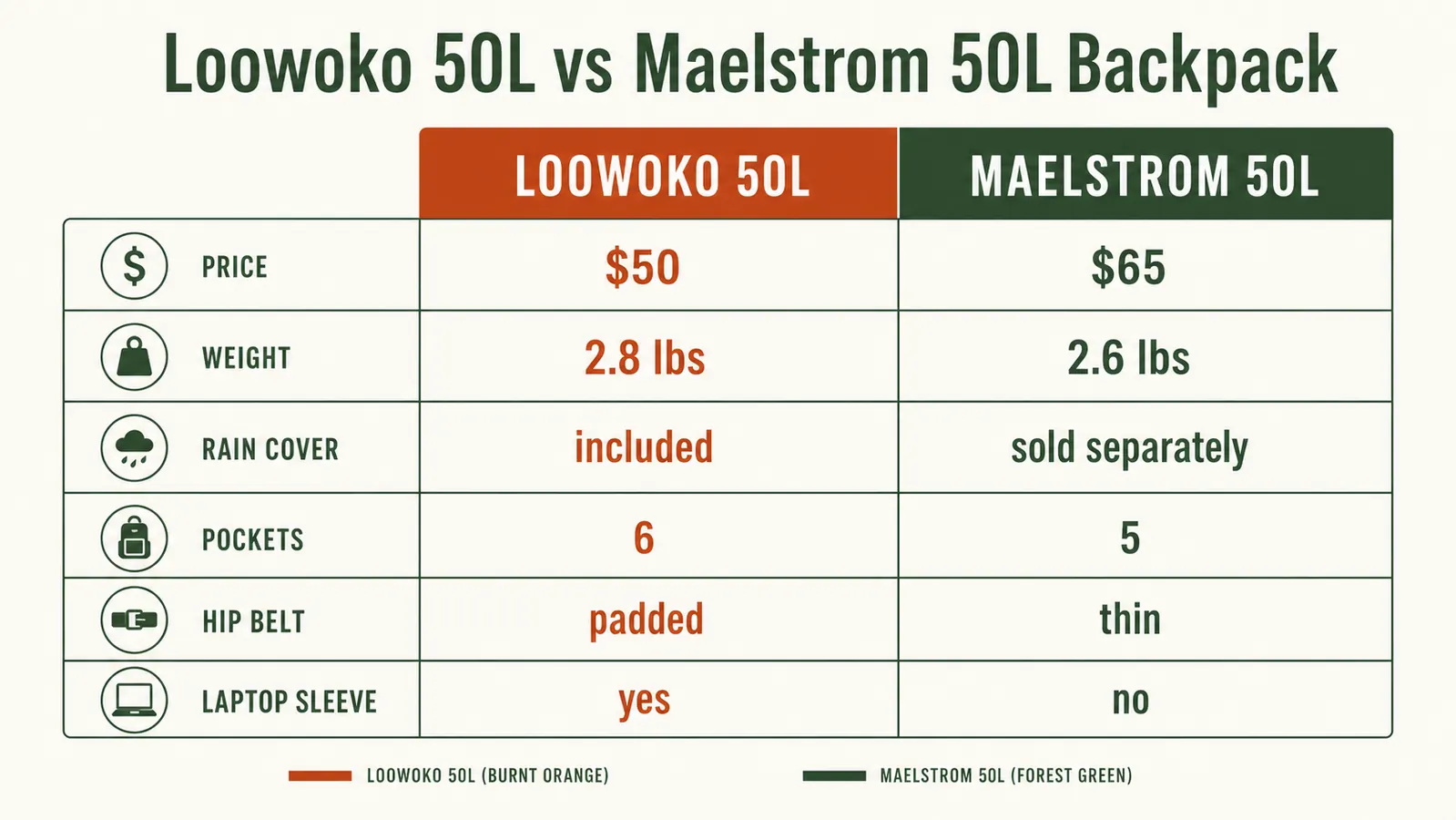
| Feature | Loowoko 50L | Maelstrom |
|---|---|---|
| Capacity | 50 liters | 50 liters |
| Weight (empty) | Approx. 2.6 lbs | Approx. 2.9 lbs |
| Internal Frame | Yes, aluminum stay | Foam panel only |
| Hip Belt | Padded, load-bearing | Basic strap, minimal padding |
| Waterproofing | Water-resistant nylon + included rain cover | Water-resistant coating only, no rain cover |
| Rain Cover Included | Yes, stored in bottom pocket | No |
| Main Compartments | 3 (main, secondary, front mesh) | 2 (main, front zip) |
| Hydration Compatible | Yes, sleeve and port included | Yes, sleeve included |
| Current Price | Around $50 | Around $55-65 |
Where the Loowoko 50L Wins
The single biggest difference between these two packs is the frame system. The Loowoko has an actual aluminum stay running up the back panel. That sounds like a minor spec, but you feel it after five miles. On my first trip with the Loowoko, I loaded it to about 28 pounds with a sleeping bag, sleeping pad, food for two nights, and a one-person tent, and the pack tracked solidly against my back instead of swaying side to side with every step. The weight sat on my hips instead of dragging on my shoulders. On the Maelstrom trip with the same load, my shoulders were noticeably sore by mile four because the foam back panel simply cannot channel weight into the hip belt the way a rigid aluminum stay can. That difference compounded with every mile.
The rain cover is the other thing I kept coming back to. The Loowoko stores a bright orange rain cover in a dedicated bottom pocket, which means it's always with the pack and you're not scrambling to find it when the sky opens up. On my Maelstrom trip, a short thunderstorm rolled through Saturday afternoon and I had to dig a separate dry bag and a makeshift cover out of my stuff sack because the Maelstrom doesn't include one. The Loowoko's included rain cover is a small feature that matters a lot on a real trip, especially if you haven't built out your complete kit yet. It's also a safety net for the moment you're too tired at camp to dig through a bag.
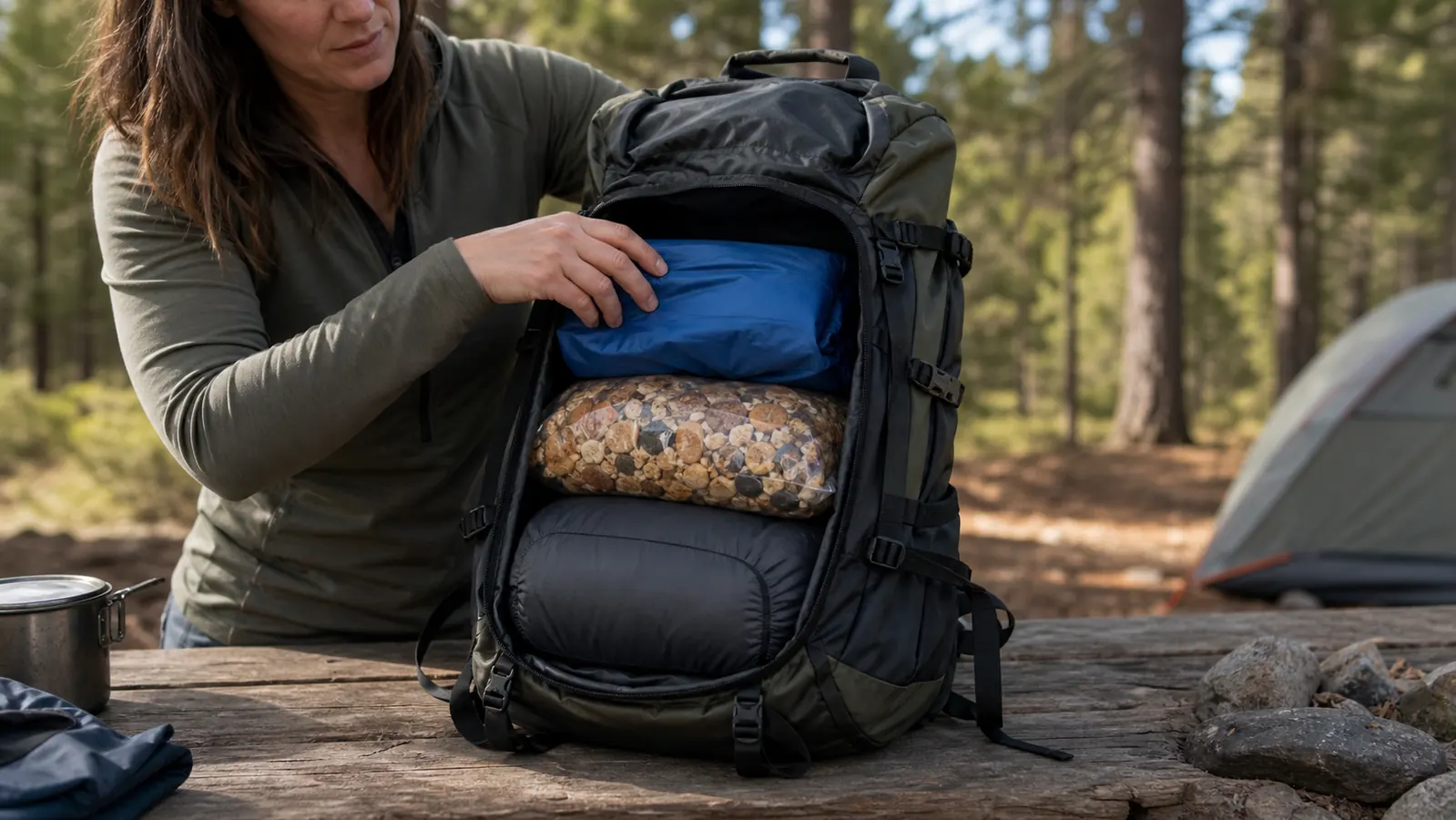
Organization is a third place the Loowoko pulls ahead. Three distinct compartments, a hydration sleeve with a routing port, and external attachment points for trekking poles give you enough structure to keep your kit sorted without being fussy about it. The two-zip layout on the Maelstrom works fine for a day hike, but when you're fitting in a full overnight kit you end up with one big main compartment and one small front zip, which creates a packing experience somewhere between organized and chaotic. The Loowoko's secondary front compartment is where I keep headlamp, rain jacket, snacks, and my small first aid kit so I can grab any of it at the trailside without unpacking the whole bag.
Where the Maelstrom Wins
The Maelstrom is a touch lighter empty, which matters more to ultralight-leaning hikers than it does to typical weekend campers who are carrying a full overnight setup. If you're obsessing over base weight and every ounce counts before you've even loaded a piece of gear, that difference is real and meaningful. The Maelstrom also has a slightly wider top-loading opening, which makes it easier to stuff a bulky sleeping bag down into the main compartment without forcing it. For hikers who prefer a simple main-compartment design with few internal dividers, the Maelstrom's minimal organization is actually a feature, not a gap in the design.
The Maelstrom's shoulder straps have a dense foam that felt comfortable on short carries and flat terrain. On the three-mile flat section of my second trip, I barely noticed a difference between the two packs, and at that moment I could see why someone might read a comparison and call it a draw. The trouble is that short-carry comfort and long-carry comfort are entirely different things. Without the aluminum stay to transfer load down into the hip belt, the Maelstrom's shoulder straps are doing more work than they should once the miles pile up and your pack shifts forward. If your trips are under six miles with a light 15-pound day load, the Maelstrom is probably fine for what you're asking of it.

After mile five with 28 pounds on my back, the pack with the aluminum stay won. Not because of any spec on the listing, but because my shoulders said so.
The pack with the frame, the rain cover, and the track record is still under $50.
If you're headed out for an overnight trip and need a 50L pack that won't quit on the descent, the Loowoko 50L is the one Marcus carries. Over 5,600 Amazon buyers agree it's worth the price. Check current pricing before your next trip.
Amazon Check Today's Price on Amazon →Load-Bearing and Comfort Over Long Miles
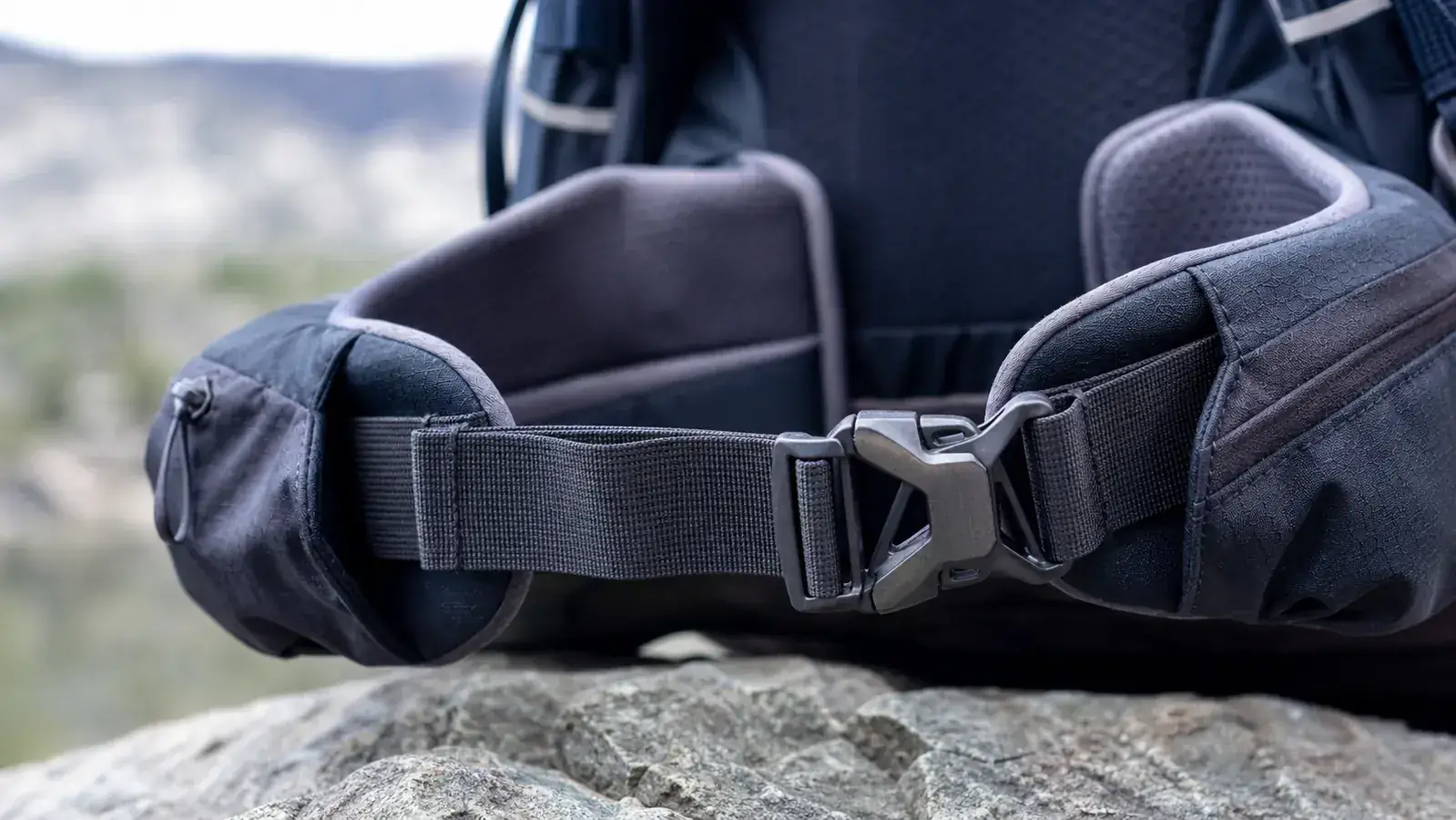
Load transfer is where budget packs either earn their price tag or expose themselves. The Loowoko's padded hip belt is wide enough to actually grip your iliac crest and take weight off your spine. With 28 pounds loaded, my shoulders were carrying maybe a third of that and the rest was riding on my hips where it belongs. That is exactly what a properly fitted pack should do, and it is not something you can replicate with a foam-only back panel and a thin strap. The hip belt on the Loowoko has enough density to stay put on the downhills without riding up or folding in half.
I'm 6-foot-1 with a long torso, and the Loowoko's adjustable sternum strap and load lifter straps let me dial in the fit without feeling like I was working around a compromise. The shoulder straps are wide and curved enough to sit naturally without digging. I've carried more expensive packs on shorter trips that didn't feel as sorted as the Loowoko does at mile eight. The Maelstrom fit my frame okay, but the hip belt kept riding up during descents, which meant I was gradually loading more weight onto my shoulders as the day went on. That is a frame problem, not a fit problem, and no amount of strap adjustment fixes the underlying geometry.
Durability and Material Quality
The Loowoko uses a 600D polyester shell with a water-resistant coating. That rating means the fabric handles brushing against wet branches and sitting on damp ground without soaking through in light rain, but it is not a fully waterproof membrane. The included rain cover is what keeps your load dry in a real downpour, which is actually honest design. A budget pack that claims fully waterproof construction is usually cutting corners somewhere else to make that claim possible. The Loowoko gives you a coated shell plus a real rain cover, which is the right combination at this price point.
I put the Loowoko through a creek crossing on my third trip, a slippery rock ford that soaked the lower third of the pack for about ten seconds. The water-resistant fabric kept the damage to a small damp patch on the outside, and everything inside stayed dry. The zippers on all three compartments still run smooth after eight weekends of use and two solid drenchings. Nothing has frayed at stress points, popped at the seams, or jammed. For a pack at this price, that is a genuine pass. The Maelstrom's stitching looked thinner at the shoulder strap attachment points, which is the highest-stress zone on any loaded pack. I would not bet a multi-night trip on those seams holding indefinitely.
Value and What You Get for the Money
The Loowoko 50L carries 4.5 stars across more than 5,600 Amazon reviews. That kind of rating at that volume of reviewers is not a coincidence and it is not the product of a few enthusiastic early buyers. It reflects a consistent experience across a wide range of hikers and campers at different skill levels. At around $50, you're getting an aluminum-framed pack with a padded hip belt, an included rain cover, a hydration sleeve, and three distinct compartments. Packs with those same specs from name-brand outdoor companies typically start closer to $100 to $150. The Loowoko's value is real and earned, not just relative to its own price point.
The Maelstrom often lists a little higher than the Loowoko despite delivering fewer functional features. No rain cover means you're buying one separately. The basic hip belt means your shoulders are doing extra work on longer days. The two-compartment layout means more time digging through your pack at camp. For a casual day hiker with a light load and short distances, none of those gaps matter much. But for anyone planning overnight trips or longer trail days with 20-plus pounds of real gear, those gaps add up in ways that affect your actual experience on the trail.
Who Should Buy the Loowoko 50L
The Loowoko 50L is the right pick for weekend hikers and overnight campers carrying real gear weight, somewhere in the 20-to-35-pound range, over trail distances of five to fifteen miles. It fits beginners who are buying their first serious pack and don't want to spend $150 learning whether backpacking is something they'll stick with. It also fits experienced campers who want a reliable backup pack, a dedicated travel-light setup, or a frame pack they're not worried about checking on a flight. The aluminum frame, the included rain cover, and the three-compartment layout make it versatile enough across a wide range of uses. If you're going out in mixed weather and carrying overnight kit, this is where to spend your money.
Who Should Skip the Loowoko and Look Elsewhere
If you're doing day hikes with loads under 15 pounds and you never camp in weather, the Maelstrom is a reasonable pack and you might prefer its slightly lighter empty weight and simpler layout. If you're a dedicated ultralight hiker who is intentionally running a frameless setup because you've dialed your gear list down below 15 pounds and you know how to distribute load without a frame, either pack can work but neither is purpose-built for that style. And if your budget goes up to $100 or more, there are better-designed packs in that range from Osprey and REI that will outlast both of these by several years of hard use. But for the $50 weekend camping budget, the Loowoko is the one I would buy again.
Don't let your shoulders pay for a weak hip belt on the next trip.
The Loowoko 50L has the aluminum frame, the padded hip belt, and the included rain cover that make a real difference when your pack weighs 30 pounds and the trail gets long. More than 5,600 hikers have put it through its paces. Check today's price before your next outing.
Amazon Check Today's Price on Amazon →