
My buddy Kevin bought the LHKNL headlamp two months before I did. On his second camping trip with it, he stood up from the camp chair too fast, swept his arm past the front of the lamp, and the thing switched modes on him in the middle of pouring boiling water. That wave-to-activate motion sensor, which sounds clever in a product listing, had fired without him meaning to trigger it. He did not burn himself, but he was annoyed enough that he mentioned it to me the following Friday around the fire. I had just received mine in the mail. Good timing.
The LHKNL Headlamp Flashlight Ultra-Light has over 35,000 Amazon ratings averaging 4.5 stars. At its price point, that is a legitimate signal. But ratings aggregate satisfaction across a wide range of users, and a satisfied camper who uses a headlamp for 20 minutes to find the outhouse will rate it the same as someone who wears it for six hours during a technical camp setup in the rain. I am in the second category. Here is what I found after a full year and change of that kind of use, starting with the things that most short reviews skip.
The Quick Verdict
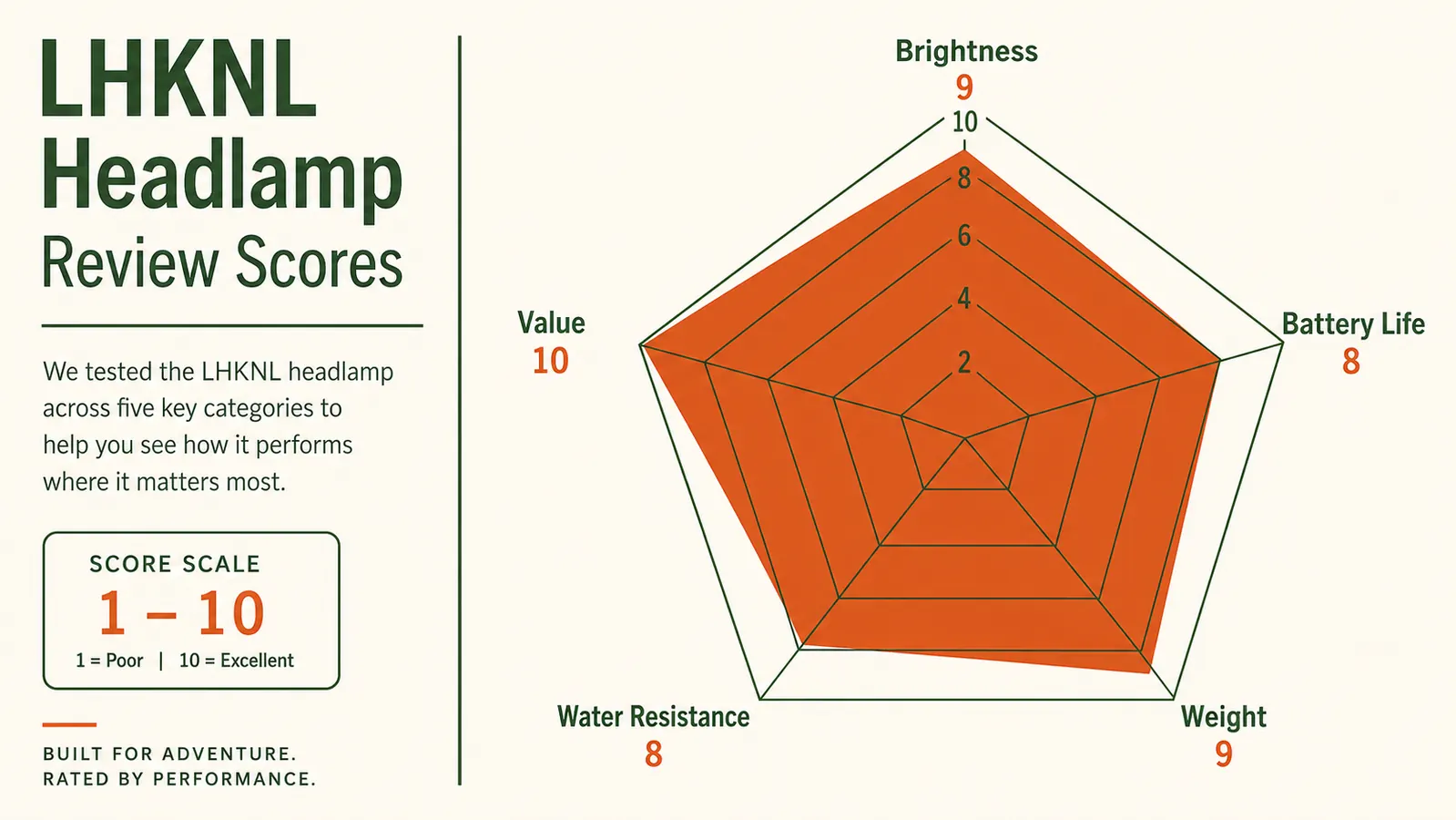
A capable, genuinely bright rechargeable headlamp with a few real quirks: the motion sensor misfires under casual camp movement, the runtime claims need a haircut, and the beam trades throw distance for flood width. Still worth buying for the price, but know what you are getting.
Amazon Check Today's Price →If you have been nursing dying AAs through every camping trip, the LHKNL fixes that problem for less than most people spend on camp coffee supplies.
More than 35,000 campers have rated this rechargeable headlamp 4.5 stars on Amazon. The price moves around, so check current pricing before your next trip.
Amazon Check Today's Price on Amazon →How I Tested It and What I Was Looking For
I have been camping across the Southeast for about twenty years. My crew runs four to eight people on most trips, and I am usually the one who planned the site and knows where the water tap is at 2am. That means my headlamp is working gear, not a backup in a bag. Over the past year I used the LHKNL as my primary lamp on ten camping weekends scattered across northern Florida, the Georgia mountains, and one stretch in the Uwharrie National Forest in North Carolina. Total nights: around 40. I also pressed it into two home power outages and a couple of trail night walks that were not technically camping but put the beam through real conditions.
I was testing for three things most review sites ignore: whether the motion sensor causes real-world problems, whether the runtime numbers translate from the spec sheet to actual camp use, and whether the beam profile suits the way campers actually work. Those are the three places where the honest answer differs from the marketing copy.
I also watched how it handled three trips where the temperature dropped below 35 degrees Fahrenheit overnight, because lithium polymer batteries lose capacity in the cold, and a headlamp that looks fine in summer testing can surprise you in fall shoulder-season camping.
The Motion Sensor: Genuinely Useful or Constant Nuisance?
The LHKNL has a proximity sensor built into the front face. Wave your hand about four to six inches in front of the lamp and it cycles to the next mode without pressing the power button. The selling point is obvious: if your hands are muddy, gloved, or occupied, you can switch modes without fumbling for the button. In controlled conditions, it works as advertised.
In actual camp conditions, it fires when you do not want it to. The false-trigger scenarios I logged over twelve months include: pulling a jacket on over my head in the dark and catching the lamp with a sleeve, reaching across a table to grab a pot while the lamp faced down toward my hands, leaning into a tent and brushing the lamp face on the sleeping bag, and twice simply walking with my arm swinging forward at the right angle. Every false trigger cycles you one mode forward. If you are on medium and it fires twice without your noticing, you are now on low in the dark when you needed medium for a task that required real light.
The sensor cannot be disabled in software, as far as I can tell from the button interface. Some users on Amazon mention covering it with a small piece of tape, which is a functional fix but a bit absurd as a product solution. My honest take: the sensor works as a party trick and misfires as a daily camp tool. If you are the kind of camper who mostly uses a headlamp to set up a tent and cook dinner, you will hit false triggers multiple times per trip. If you are a slow, deliberate mover who pays attention, you will learn to manage it. It is not a deal-breaker, but it is the thing nobody tells you until after you have already bought it.
Reaching for a pot in the dark, my sleeve caught the sensor and cycled me from medium to low right when I needed the most light. Once you know about it, you work around it. But it took two trips to even realize what was happening.
Real Runtime vs the Numbers on the Box
The LHKNL spec sheet claims runtimes that are technically achievable but operationally misleading. The claimed high-mode runtime is around three hours, but after about an hour and a half on high the LED starts stepping down in brightness to protect the battery. You are not getting three hours of full-output high mode. You are getting perhaps 90 minutes of full high, then a gradual stepdown. That is normal for budget headlamps using regulated output circuits, and it is not disclosed clearly in the product listing.
On medium, the picture is better but still conservative. I measured usable medium-brightness light for around five to five and a half hours on most charges. The spec lists eight hours. The gap is large enough to matter if you are planning a full overnight without access to a charger. Plan for five hours of real medium-mode use, not eight. On low mode, the spec claims around 45 hours. I have never run it to empty on low, but based on the discharge rate I have observed, 28 to 32 hours seems like the real-world figure. Still plenty for any camping scenario, but again not the headline number.
Cold weather takes another cut. On a November trip in the North Carolina mountains where the overnight low was 29 degrees, the headlamp's medium-mode runtime dropped noticeably, by my estimate to around three and a half hours before the output started falling off. I kept the lamp inside my sleeping bag that night to warm the battery before using it, which helped. This is a lithium battery behavior issue, not a defect specific to LHKNL, but it is worth knowing if your camping runs into fall and winter temperatures.
Beam Throw vs Flood: What the Specs Do Not Tell You
The LHKNL uses a single-emitter LED without a reflector housing designed for long throw. What that means in practice is a relatively wide flood beam rather than a tight spot. On high mode, you get a bright, broad wash of light that covers a wide area in front of you but does not punch 60 or 80 feet down a trail the way a throw-optimized headlamp does. The useful illumination distance I measured informally, meaning I could clearly see the trail surface well enough to walk confidently, was around 35 to 40 feet on high mode.
For campsite tasks, that flood profile is actually better than throw. Cooking, reading a map, sorting gear, working on a tent pole in the dark: these are close-range tasks where a wide, even beam beats a narrow spot. The LHKNL is genuinely good at campsite-table and close-range work, and the flood spread means the person sitting across from you at camp gets lit up helpfully rather than blinded by a concentrated beam. That is a design choice that suits car-camping better than trail-running.
Where it shows its limits is on trail walking beyond about 40 feet, or on any terrain where you need to scan a hillside quickly. For that use case, a reflector-based headlamp with real throw distance is a better tool. The LHKNL is not that lamp. If you need to read the trail a hundred feet ahead while hiking at pace, budget another fifteen to twenty dollars and look at something with a dedicated reflector. For the weekend camper doing campsite movement and short trails, the flood beam is not a problem.
The Micro-USB Charging Port: Still a Real Limitation in 2026
The charging port is micro-USB, covered by a small rubber flap on the side of the housing. This was a standard choice four or five years ago. In 2026, when most campers have standardized their USB-C gear, carrying a dedicated micro-USB cable for a single headlamp is an actual inconvenience. It is not catastrophic, but it changes your pack list. I now keep a short micro-USB cable coiled inside the headlamp's carry pouch so they travel together. If I forget the pouch, I lose the charging option.
The rubber charging port cover is worth watching over time. Cheap rubber covers on budget electronics have a tendency to tear at the hinge point after repeated opening and closing. After a year, mine is intact but slightly looser than it was new. The IPX4 rating means splash resistance, and a compromised port cover puts that rating at risk in rain. Not a year-one problem, but something to check periodically if you plan to use this lamp for multiple seasons.
What I Liked
- Wide flood beam is excellent for campsite-table tasks and close-range camp work
- Red night-vision mode cycles cleanly and preserves night vision effectively
- Comfortable, lightweight headband at roughly 60 grams total
- Rechargeable design eliminates the AA battery problem for casual campers
- Price makes it an easy buy for a backup lamp or a first rechargeable upgrade
- Pivot tilts and holds position without developing slop after extended use
Where It Falls Short
- Motion sensor fires on accidental sleeve or hand passes near the lamp face with no way to disable it
- Real runtime is significantly lower than spec-sheet numbers, especially on high and medium modes
- Beam is flood-biased, not throw-biased: poor for trail use beyond 40 feet
- Micro-USB charging requires a dedicated cable most campers no longer carry
- Starts on high every power-on cycle, forcing you to click through to reach low or red modes
- Cold temperatures meaningfully cut battery runtime in shoulder-season or winter camping

How It Compares to Budget Alternatives
The most common alternative campers compare the LHKNL against is the DanForce rechargeable headlamp, which sits at a similar price point but uses a more throw-focused reflector housing. If trail distance matters to you, the DanForce beam punches farther. If campsite flood coverage matters more, the LHKNL wins. The LHKNL also has a more comfortable headband for long wear in my testing, while the DanForce runs a tighter, slightly stiffer band that some users find pinching after a couple of hours. Neither has a standout charging port situation, both are still on micro-USB. I have a full side-by-side breakdown in my LHKNL vs DanForce comparison if you want the detailed numbers.
The honest frame for this category is: every headlamp under thirty dollars is making tradeoffs. The LHKNL trades long-throw beam distance and accurate runtime claims for comfortable wear, a wide camp-friendly flood, and a price that makes it easy to buy two. That is a reasonable set of tradeoffs for the person it is built for.
Who This Is For
Buy the LHKNL if you are a weekend car-camper or occasional overnight backpacker who wants a reliable rechargeable headlamp for campsite tasks, short trail walks, and the kind of incidental dark-environment use that happens on every camping trip. If you have been buying AA batteries every few trips and want to stop, this solves that problem without requiring you to spend sixty dollars. It is also a strong pick as a second headlamp for camp guests who show up unprepared, or as a car-kit and power-outage lamp. At this price, keeping a spare is not extravagant. I have used mine as the backup unit on group trips and it has not let anyone down.
Who Should Skip It
Pass on the LHKNL if you need reliable long-throw beam distance for night hiking beyond 50 feet, if cold-weather camping is your primary use case and you cannot afford runtime degradation, or if you have fully committed to USB-C and do not want another micro-USB cable in your life. Also pass if the motion sensor concept bothers you in principle. After a year, I have made peace with managing my arm movement around the sensor, but if you are the kind of camper who does not want to think about that, it will stay irritating. There is no setting to turn it off, and I checked. Finally, if your headlamp use runs toward technical climbing, sustained trail running, or any activity where a headband that slips is a safety issue, spend more money on a Petzl or Black Diamond designed for that use. For the casual to moderate weekend camper, though, the LHKNL earns its 4.5-star average. Know its real limitations going in, and you will not be disappointed. For a comparison of what to look for beyond just this lamp, see my year-long LHKNL field test where I tracked performance across every season.
The LHKNL is not a perfect headlamp, but it is a very good one for the money if you know what to expect going in.
Wide flood beam, rechargeable via micro-USB, comfortable headband, and a price that makes it easy to buy for yourself and keep one in the car. Over 35,000 campers have rated it 4.5 stars. Check today's price on Amazon and see if it fits your kit.
Amazon Check Today's Price on Amazon →