
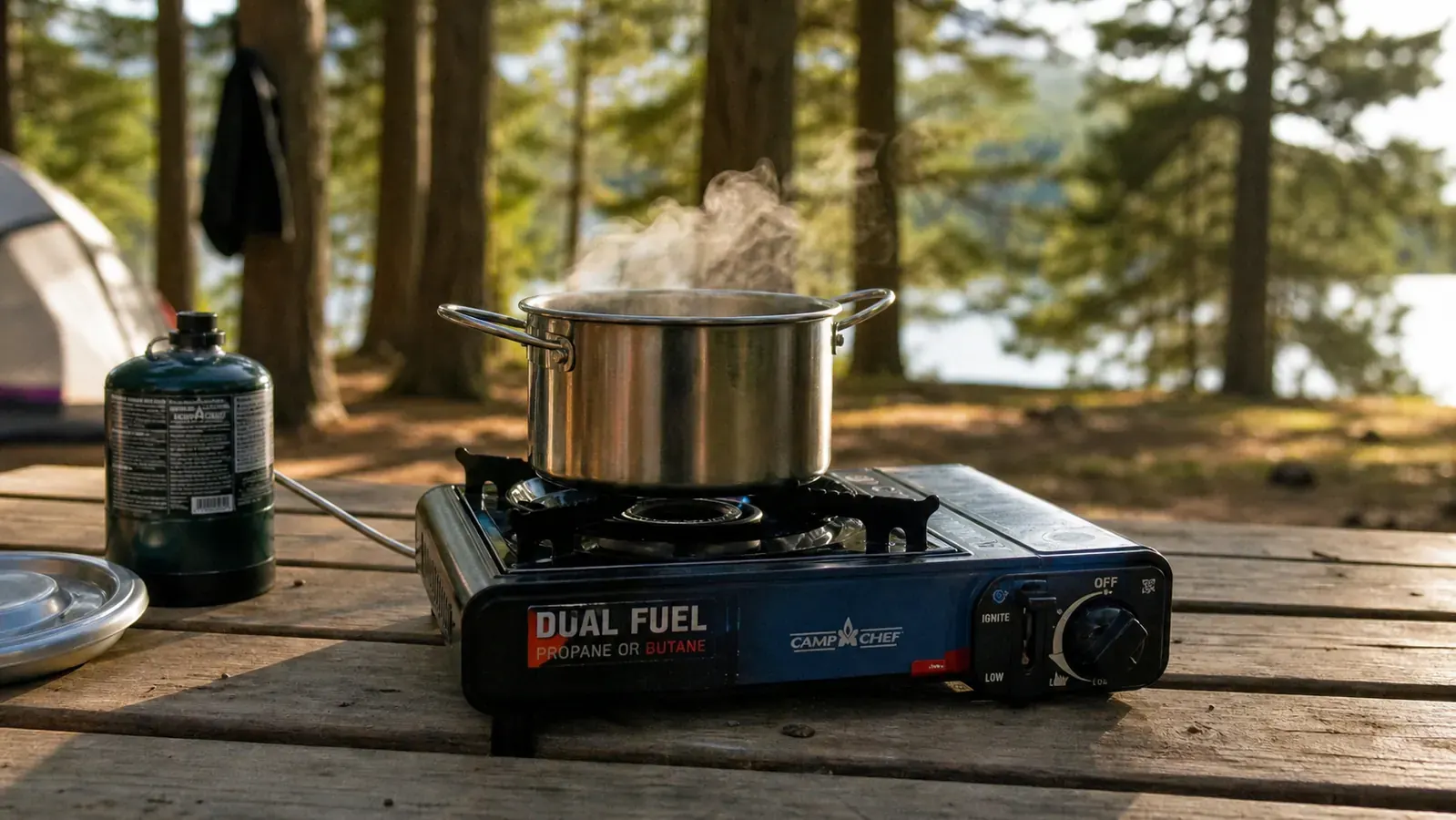
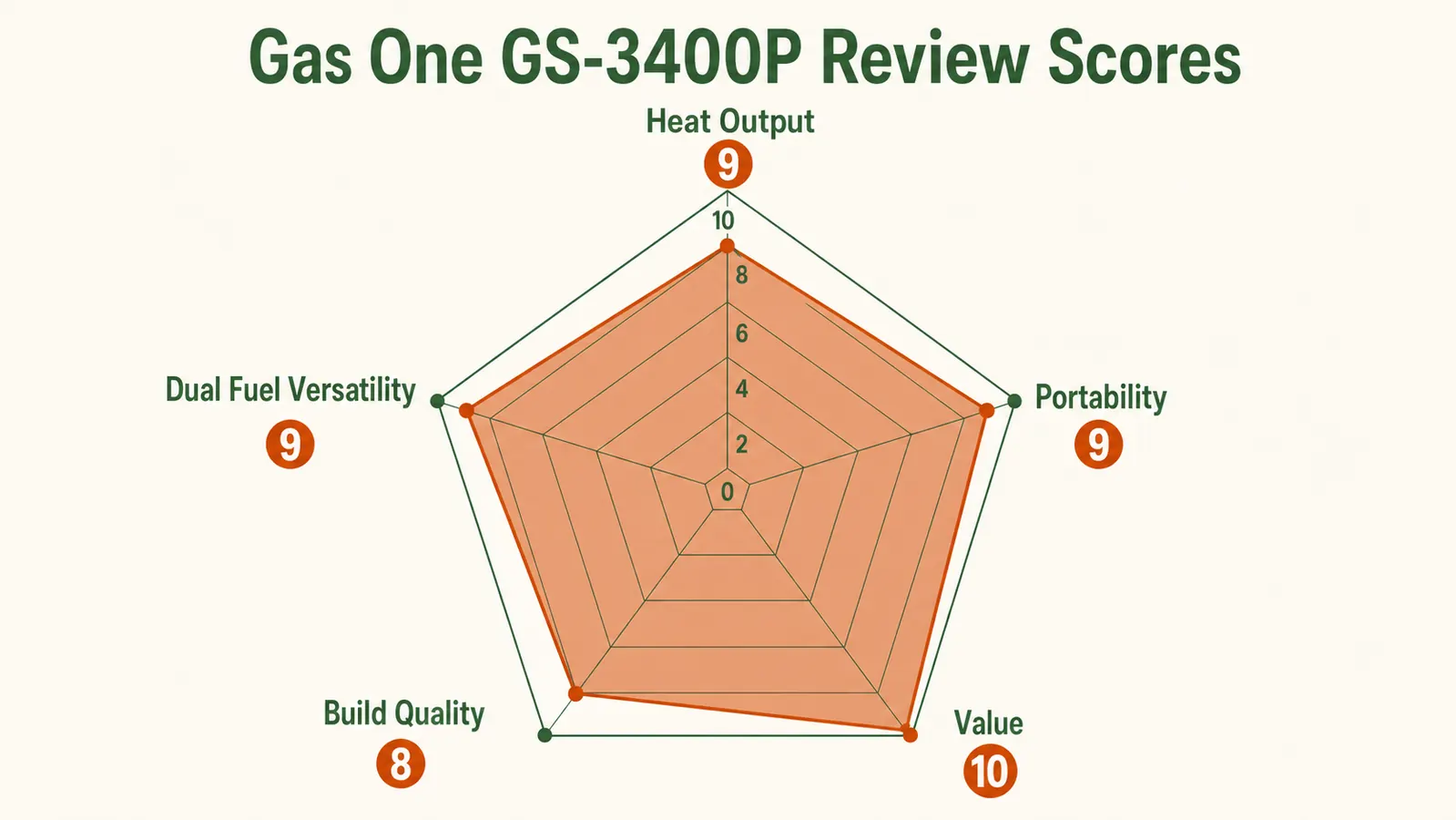
Most reviews of the Gas One GS-3400P will tell you it is a versatile, affordable dual-fuel stove that accepts both propane and butane. That is true. What they will not tell you is that it has real wind exposure issues, that simmer control is more of a suggestion than a guarantee, and that the propane-vs-butane choice matters a lot more than the box makes it sound. I have been cooking on this stove at campsites in Missouri, Tennessee, and Arkansas for two seasons now. I have used it on calm summer mornings and on breezy October ridgelines, and the experience is different enough between those two settings that they almost feel like separate stoves. This review is about both of those stoves.
The Gas One GS-3400P costs around $30 new and accepts both standard 1-lb propane canisters (the green Coleman cylinders you can find at any Walmart) and butane canisters via an included adapter. At 4.6 stars across nearly 15,000 Amazon reviews, it is the kind of product that is genuinely good, just not perfect. If you want the full two-season field report, keep reading.
The Quick Verdict
Solid, compact, and genuinely flexible on fuel, but wind performance and imprecise simmer control keep it from being an everyday recommendation for exposed campsites or precision cooking.
Amazon Check Today's Price →Tired of spending $80 on a stove when $30 gets the job done?
The Gas One GS-3400P is what I hand to anyone just getting into camp cooking. Check today's price on Amazon and see if it fits your setup.
Amazon Check Today's Price on Amazon →The Wind Problem Nobody Warns You About
Here is the thing that surprised me most, and it is not in any product listing I have ever seen: the GS-3400P has no wind baffles. The burner head sits completely exposed. On a still morning in a sheltered campsite, that does not matter at all. The flame is steady, the boil time on a liter of water is around 4.5 to 5 minutes with propane, and it feels like a capable little stove. Take it up to a ridgeline or a lakeside site where the breeze picks up, and the flame starts doing things you did not ask it to do.
On a trip to Land Between the Lakes in October, I had consistent 10-to-15 mph winds rolling off the water. The stove would light fine, but the flame blew sideways enough that a pot of water that should have boiled in five minutes took closer to ten. Not a disaster. But if you are counting on this stove for efficiency at a breezy lakeside spot or a mountain campsite, you need to build your own wind protection. I now carry a small folding windscreen -- they run about eight dollars and fold flat in a pack pocket. It completely solves the problem. But the stove should not need a workaround to perform at basic outdoor tasks.
If you are primarily a car-camper setting up in the middle of a sheltered site with trees breaking the wind, this may never matter to you. If you ever cook in open or exposed spots, budget for that windscreen on day one.
Simmer Control: Good Enough, But Not Chef Territory
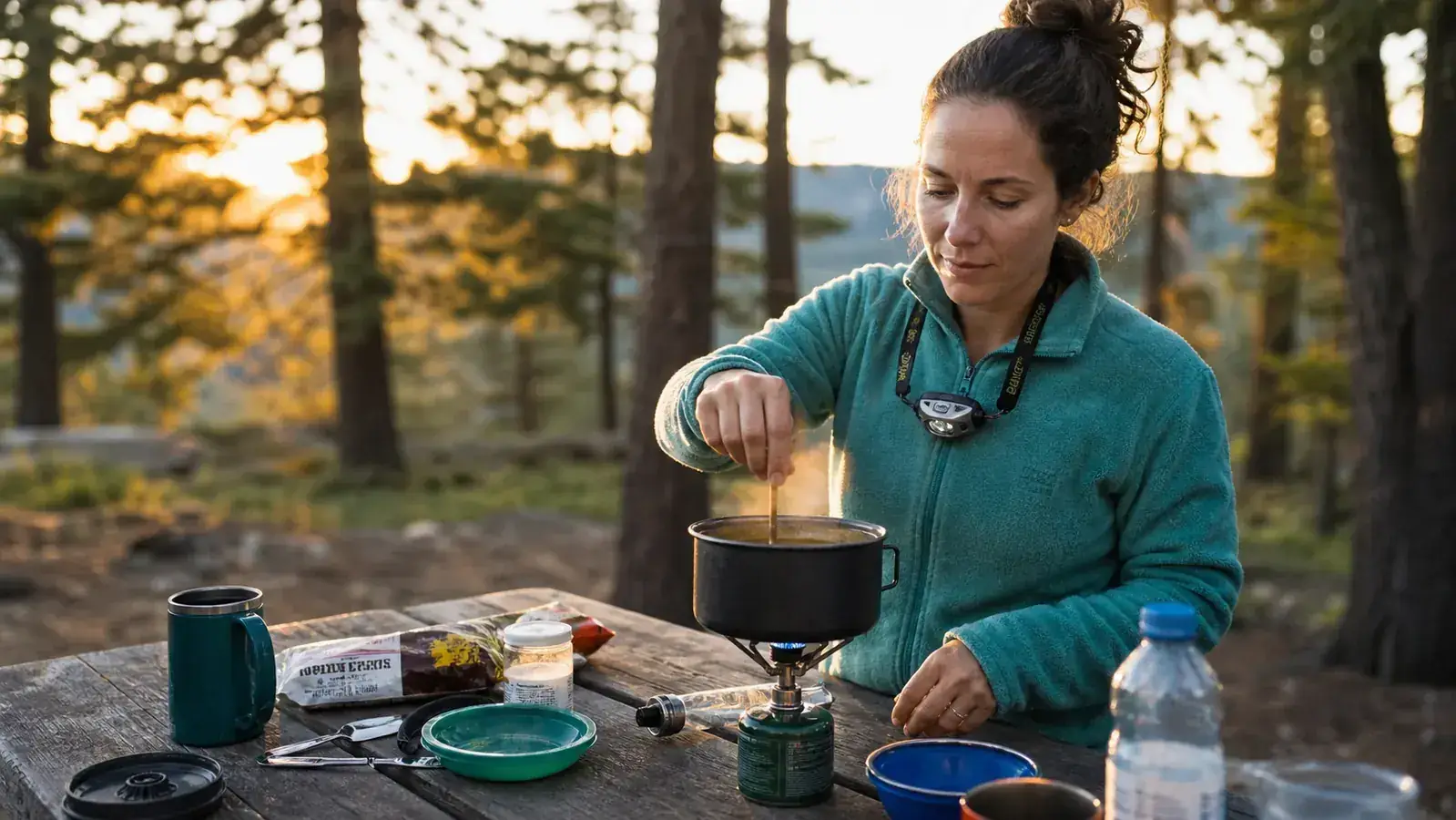
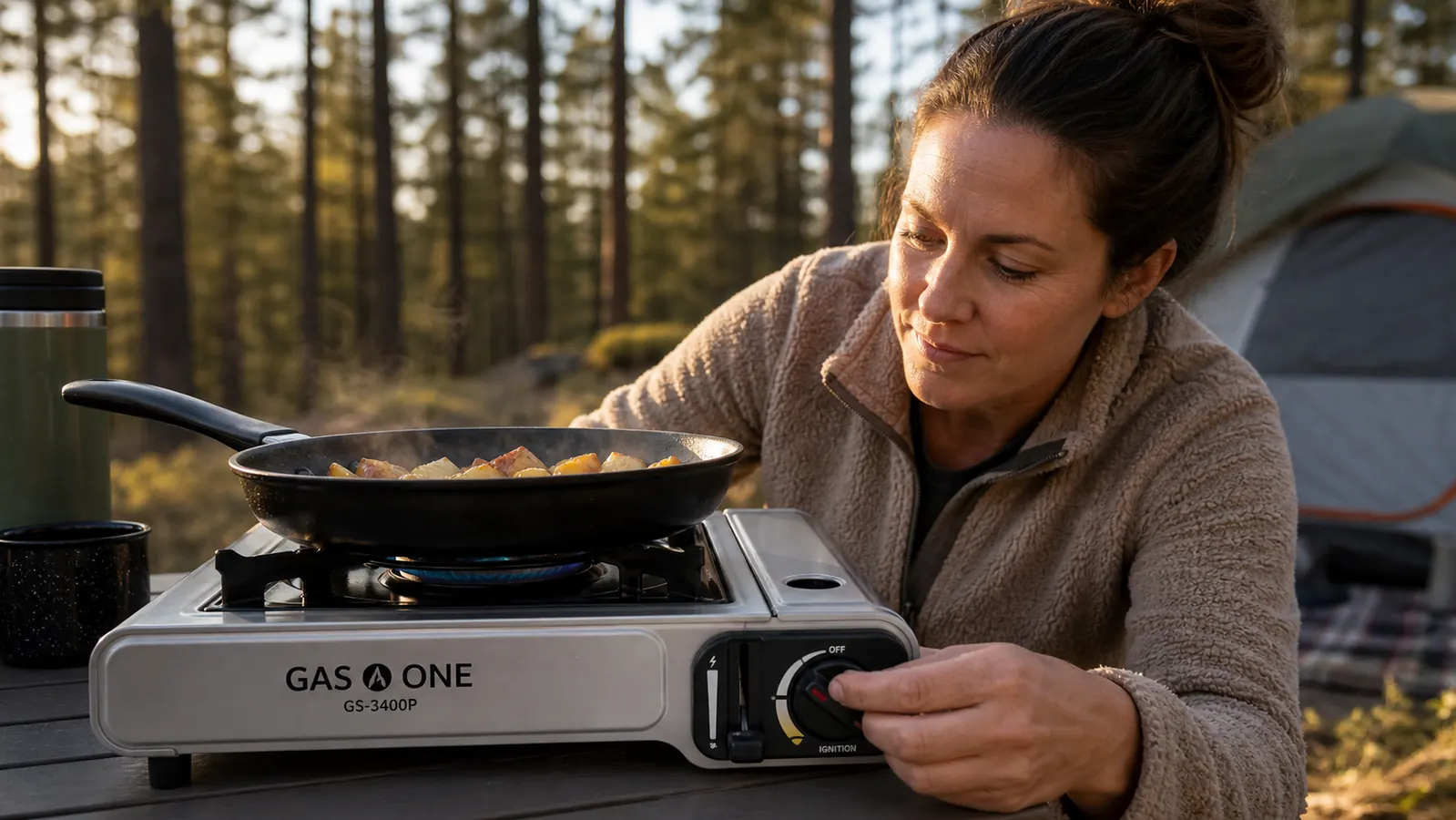
The control valve on the GS-3400P has a decent range of travel, but the low end is jumpier than I would like. Getting a true, sustained simmer for something like chili or pasta sauce requires some fiddling. You turn the knob down, the flame drops, and then it either stabilizes at a decent low or it hiccups a few times and climbs back up. I would call the effective simmer range about 40 percent of what you might get on a quality backpacking stove.
For most campsite cooking, this is a non-issue. Boiling water for coffee or oatmeal, heating soup, cooking eggs and bacon, frying sausage -- none of those require tight simmer control, and the stove handles all of them well. Where I noticed the limitation was when I tried to make a 20-minute tomato sauce on a car-camping trip with my brother. The sauce scorched twice before I got the valve dialed in, and I ended up propping the pot slightly off-center to cheat the heat. That is the kind of edge case most weekend campers will never hit, but if you cook with any ambition at camp, know what you are working with.
The GS-3400P is a great stove for the 80 percent of campsite cooking most people actually do. The other 20 percent is where you start to feel its limits.
Propane vs Butane: The Choice Actually Matters
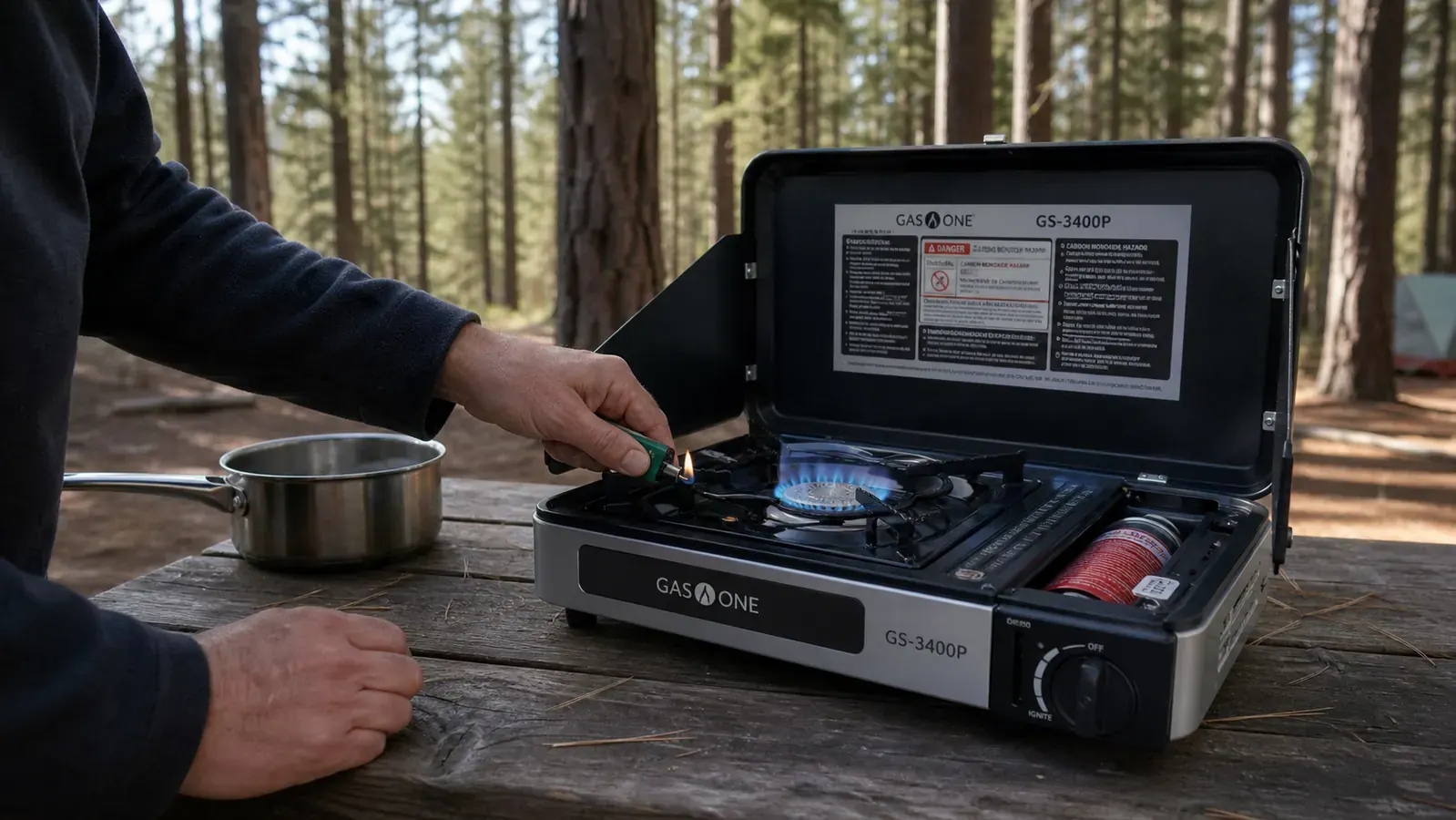
The dual-fuel feature is the main selling point of the GS-3400P, and it delivers real flexibility. But the propane-versus-butane decision is not just a fuel preference -- it has practical consequences that the product listing glosses over.
Propane maintains usable pressure down to around 20 degrees Fahrenheit. Butane drops off noticeably below 40 degrees -- you will notice the flame getting weaker on a cold morning before your campsite has warmed up. In April in the Ozarks, where temperatures can dip to the mid-30s overnight, I pulled out a butane canister one morning and the stove barely lit. Swapped to propane and it fired up instantly. If you camp in spring or fall, or anywhere that temperatures drop near or below freezing, propane is the right call.
On the other side of the equation: butane canisters are cheaper per ounce of fuel, they are easier to find at Asian grocery stores and international markets, and they burn slightly cleaner in warm conditions. If you are a summer-only camper and you are trying to keep costs down, butane works fine and saves you a few dollars over a season.
The included butane adapter hose works well. It is a short flexible hose that connects a standard butane canister to the stove's threaded fitting. I had one minor issue where the adapter connection loosened during transport and I smelled gas when I opened my camp kitchen bag. Snugged it tight and it was fine, but I would recommend leaving the adapter disconnected and canisters separate when packing for a trip. Standard safety stuff, but worth mentioning since the adapter is a loose part that can work itself out.
Build Quality: Honest Take on a $30 Stove
The GS-3400P is built from painted steel with a folding steel grate. It is heavier than a backpacking stove and lighter than a two-burner car-camping setup, sitting right around 1.5 lbs. The construction feels appropriate for the price. The grate folds in and the unit packs down reasonably flat. Nothing feels flimsy in a dangerous way, but nothing feels like it was built to last a decade either.
After two seasons, the paint on the burner ring has heat-discolored, which is normal and expected. The folding grate still locks in place without slop. The valve knob feels the same as it did new. No rust despite being exposed to rain on two separate trips. For a $30 stove, that longevity profile is actually pretty solid. I would not trust it to the same level I trust my MSR WhisperLite after fifteen years, but those two stoves are not in the same conversation on price.
One thing I will flag: the pot supports on the grate are not wide enough to safely hold anything larger than about a 10-inch skillet or a 2-liter pot. I tried setting a large 12-inch cast iron skillet on it once, it wobbled badly, and I went back to the campfire grate for that meal. Size your cookware to the stove and you will be fine.
What I Liked
- Genuinely accepts both propane and butane with the included adapter, no extra parts to buy
- At around $30, the lowest barrier to entry of any dual-fuel stove I have used
- Lights easily and reliably in calm to moderate conditions
- Compact enough to fit in a medium daypack side pocket or a camp kitchen bag
- Solid boil performance in sheltered conditions: 1L in under 5 minutes on propane
- Durable enough finish after two seasons of real use with no rust or structural failures
Where It Falls Short
- No wind baffles on the burner head; needs an external windscreen in any open or breezy spot
- Simmer control is imprecise at the low end; scorching risk on sauces and delicate dishes
- Butane performance drops sharply below 40 degrees Fahrenheit -- a real issue in spring or fall camping
- Pot grate is too narrow for anything wider than a 10-inch pan; cast iron or large skillets are not safe
- Butane adapter is a loose part that can work itself out in transit if not separated from the canister
How It Compares to What I Used Before
Before I picked up the GS-3400P, I was using a single-fuel Coleman BottleTop stove. The BottleTop screws directly onto a standard propane canister, which means one fewer part to manage. It is arguably sturdier and the burner design handles moderate wind a touch better because the canister sits lower and acts as ballast. But it only accepts propane, which limits your options if you are in a part of the country where 1-lb green propane canisters are hard to find quickly.
The GS-3400P beats the BottleTop on fuel flexibility and beats it on price. The BottleTop edges it on wind stability and simmer consistency. If you want to dig into that comparison in more detail, I did a side-by-side cook test on the same campsite in my comparison article. For most beginners, the GS-3400P's extra fuel flexibility is worth more than those marginal performance edges.
I have also used the GS-3400P alongside a Jetboil Flash on a group trip where my buddy brought the Jetboil. The Jetboil boils water in roughly half the time and has a built-in insulating cozy that retains heat. It also costs five times as much as the Gas One and only accepts proprietary Jetboil fuel canisters. For pure coffee-and-instant-oatmeal efficiency, the Jetboil wins. For actually cooking a meal with real ingredients in a real pan, the GS-3400P is more versatile and costs a fraction of the price.
Who This Is For
The Gas One GS-3400P is the right stove for a first-time camper who does not want to spend $80 to $120 to find out whether they like cooking at the campsite. It is also the right stove for a weekend car-camper who sets up in sheltered sites, cooks simple meals, and wants a compact stove that runs on whatever fuel they can grab at a gas station or Walmart. If you fall into either of those categories, stop overthinking it. Thirty dollars and you are done.
It is also a genuinely good backup stove. I keep mine in my truck for car-camping weekends when I do not want to risk my better gear, and I have loaned it to friends heading out for their first camping trips more times than I can count. Every one of them came back saying it worked great. Because for what most people actually cook at camp, it does.
Who Should Skip It
If you cook in exposed conditions regularly, you will spend more time fighting the wind than cooking. A stove with an integrated wind guard or a lower-profile design that keeps the flame more sheltered is worth the extra money in that scenario. If you are a serious camp cook who wants to simmer stocks, make real sauces, or cook anything that requires sustained low heat, the imprecise valve is going to frustrate you. And if you camp in shoulder seasons where morning temps are below freezing, you need a stove that can handle cold-weather propane performance reliably -- which the GS-3400P can do on propane, but only if you specifically choose that fuel and know the limitation.
For ultralight backpackers, this stove is also not the answer. At 1.5 lbs, it is heavy relative to the output, and it does not fit inside a fuel canister the way a compact backpacking stove does. There are better tools for that use case.
Good camp cooking does not require a $100 stove -- most beginners do not need one.
The Gas One GS-3400P handles everything a weekend camper actually cooks. Check today's price on Amazon and see if it belongs in your kit.
Amazon Check Today's Price on Amazon →